Thursday, May 14, 2015

Ultra High Performance All-Season Tires: Which is the Best Choice?

The Ultra High Performance All-Season category has seen tremendous growth in recent years and makes a good amount of sense for a large percentage of our customer base. With a focus on both performance attributes and reasonable treadlife, this performance category appeals to enthusiasts who desire balance and year-round use out of a single set of tires. Often times, we also see customers in very mild climates migrating to this category simply seeking longer life than they would receive with a dedicated summer-only tire.
With many players in this expanding segment, there are many good choices.
Long considered the king of this category, the Continental ExtremeContact DWS seems to do everything quite well. If snow traction is a focus of yours, you would be hard pressed to find a better tire in this category. While the tire has never been the fastest in the dry, it provides flexibility in all weather conditions that is difficult to match. This tire is among our best sellers for customers in northern climates and has logged over 40 million miles in our consumer surveys!
The Michelin Pilot Sport A/S 3 is a blisteringly fast tire in the dry and wet and communicates wonderfully with its driver. It wears better than a performance summer tire due to its harder tread compound and is available in a wide array of sizes offering coverage for most popular applications. While fast and composed in the dry and wet, this tire suffers a bit in snow and is best suited for a mild climate.
While not as sharp in the dry as the Michelin, or as aggressive in the snow as the Continental, the Goodyear Eagle Sport All-Season catches a driver's eye because it is so well-rounded. It is also very well priced and is a bargain amongst other reputable brand name options. Due to its versatility, we have seen positive reviews from customers in various parts of the country.

see more at: http://www.rubbernews.com/article/20150225/NEWS/150229962/consumer-reports-names-top-tire-in-2015

Tuesday, May 12, 2015

What’s Inside a Tire


TREAD: Provides traction and cornering grip
BELTS:   Stabilize and strengthen the tread
SIDEWALL:Protects the side of the tire from road and curb damage
BODY PLY:Gives the tire strength and flexibility
BEAD:Assures an air-tight fit with the wheel
INNERLINER:Keeps air inside the tire

Modern tire technology blends a unique mix of chemistry, physics and engineering to give consumers a high degree of comfort, performance, efficiency, reliability and safety. Many tires are custom-designed to meet the stresses and performance needs specified by the maker of a particular model vehicle. Every tire is carefully inspected, and random samples are pulled for additional safety tests. As part of these tests, tires are x-rayed, cut apart and examined, run on test wheels, or road-tested to evaluate handling, mileage and traction performance. If properly cared for, tires can last a long time – usually from 40,000 to 80,000 miles, depending on the application.

How a Tire is Made
As many as two hundred different raw materials combine into a unique mix of chemistry, physics and engineering to give consumers the highest degree of comfort, performance, efficiency, reliability and safety modern technology and creativity can provide. Here are the basic steps:

Planning and Design

Many tires are custom-designed to meet the stresses and performance needs specified by the maker of a particular model vehicle. The process begins with a computer, which converts the mathematics of the car’s special needs into specifications. A prototype tire is then made to test the tire design’s ability to provide the desired characteristics. Custom-designing a tire for a particular vehicle typically takes many months of testing, inspection, and quality checks by the tire maker and the vehicle maker. Only then does the vehicle maker commit with an order.

Manufacturing

The production process begins with the selection of several types of rubber along with special oils, carbon black, pigments, antioxidants, silica, and other additives that will combine to provide the exact characteristics wanted. Separate compounds are used for different parts of the tire. A machine called a banbury mixer combines the various raw materials for each compound into a homogenized batch of black material with the consistency of gum. The mixing process is computer-controlled to assure uniformity. The compounded materials are then sent to machines for further processing into the sidewalls, treads or other parts of the tire.

For complete post go to: http://www.rma.org/tire-safety/tire-basics/

Monday, May 11, 2015

Continental kicks off multimedia campaign on more grip for Adidas shoes

It’s a common question when looking for a tire, should I get a run flat tire or not? We’ve all been in that Innovative rubber compounds deliver marked increase in grip for adidas shoes

 Three men’s marathon world records and multiple course records set
 More than 80 different running, trekking, and outdoor shoes already on the market


The many parallels between tires and shoes are not hard to find: Tires are to cars what shoes are to runners – they form the only link with the ground and must ultimately be able to transmit all of the forces involved. The rubber compounds specially developed for adidas by Continental feature particularly high levels of grip on all surfaces, helping runners to conserve energy that would go to waste in a shoe with less grip. “Through our interactive, multimedia GetYourGrip campaign, we are out to raise awareness of how the technology transfer from tires to shoes can result in performance improvements of up to 30 percent,” says Alexander Bahlmann, Head of PR, Passenger and Light Truck Tires at Continental. “The fascinating thing here is the sheer range of applications of these shoes that now extends from running, outdoor, and trekking, all the way to snowboard shoes.” 


The campaign kicks off with a breathtaking video in which a professional parkour runner or “traceur” takes on a Continental test engineer in a Multivan. The duel begins in downtown Hanover, runs over a range of different surfaces, and culminates at Continental’s unique AIBA fully automated indoor tire testing facility at the company’s Contidrom proving grounds. The technology transfer process is clearly illustrated, with several tire experts providing helpful explanations. The nerve center of the campaign is the www.getyourgrip.com website although many other communications channels form part of the activation, including Continental postings on the social network Facebook (www.facebook.com/continental) and on the video channel YouTube. 

To see complete story go to: http://www.continentaltire.com/node/3692

Saturday, May 9, 2015

Decoding MPG-e

Mpg-e was actually pretty tricky to develop. Gasoline is measured in gallons, which is a measure of volume. If you were to measure electricity use of EVs and plug-in hybrids, you’d use kilowatt-hours – which is the equivalent power output of 1,000 watts over one hour. You’re probably familiar with kilowatt-hours because that’s the unit electric companies use to compute your electric bill. So, when coming up with mpg-e, the EPA had to figure out how to convert a measure of energy use over time into a measure of volume. This isn’t just figuring out a way to compare apples to oranges. It’s more akin to figuring out a way to compare apples to land speed records.
Even though a gallon is a measure of volume, the gasoline in that gallon contains energy. You release that energy by burning it. When you burn a gallon of gas (which isn’t something we recommend you do in your backyard just because you’re bored), it generates the same amount of heat as about 34 kilowatt-hours of electricity (the EPA actually uses 33.7, but we’re rounding up). So, 34 kilowatt-hours is the rough equivalent to one gallon of gas that the EPA uses to calculate mpg-e.
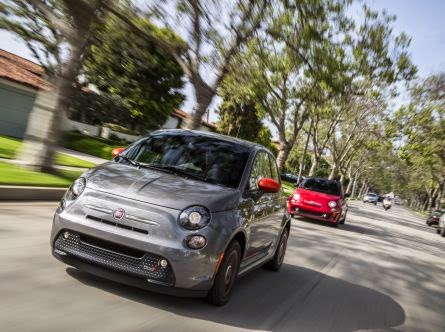
Now, for most electric car shoppers, the kilowatt-hours of electricity needed to drive 100 miles is going to be the key number, because that will determine how much you pay for electricity when charging your car. However, with mpg-e, you can translate that number into numbers that owners of gasoline-powered cars will understand. For comparison’s sake, the gas-powered Fiat 500 with an automatic transmission gets a combined fuel economy rating of 30 mpg. Based on mpg-e, the 500e uses 74 percent less energy to travel the same distance as the gas-only 500.

to see more visit: http://usnews.rankingsandreviews.com/cars-trucks/best-cars-blog/2015/04/Decoding_MPG-e/


Thursday, May 7, 2015

Michelin vs Goodyear Tires

Even those who have not done much research into tires recognize the Goodyear and Michelin brands. Being respected brands and household names, they're often sought out by shoppers as a primary choice. Decades of experience designing and manufacturing tires have given both companies a well-deserved reputation.   In order to maintain their good names, major tire companies will stand behind the quality of their tires and honor their warranties across a large network of dealers throughout the United States. If you have problems with any of their products while on the road, odds are that there's a dealer nearby that can assist.   


Michelin Pilot Super Sport
Goodyear F1 Asymmetric All-Season


So, which tire should you choose? If you're driving a sports car and looking for the best Max Performance Summer tire tire, look no further than the Michelin Pilot Super Sport. This performance tire is so great, that I bought a set for my own personal vehicle. To learn about my experience with the tire, take a look at, "Michelin Pilot Super Sport: 5,000 Mile Update."  If you're driving your sporty car through some occasional light snow and need an Ultra High Performance All-Season tire, our customers prefer the Goodyear Eagle F1 Asymmetric All-Season over the comparable Michelin offering.  

Wednesday, May 6, 2015

Toyota to Stop Prius Plug-In Production


A Toyota Prius is going out of production! Is this a sign of the end of times? Maybe this is a result of a shift in the polar regions of the Earth? Or maybe this is a sign that we actually are just living in one big hologram. Okay, that’s a little dramatic, as Toyota is only ceasing production of the Prius Plug-In because it’s too busy working on the new-generation model.
Toyota Marketing Rep, Nathan Kokes, let the Prius Chat forum know that the company has decided to cease production of the Prius Pug-In starting in June 2015. According to InsideEVs.com, however, this could pose a pretty big issue in terms of stock.
There are currently only about 1,100 Prius Plug-Ins available nationwide, and in April alone, 428 Prius Plug-Ins found new homes. Sure, that is a huge 75 percent slide when compared to April 2014 sales, but that’s still a huge percentage of the number of models available to purchase. This means that unless Toyota kicks production into high gear in May 2015, it will run out of stock by summertime.
Kokes chimed in on the speculation of running out of stock by saying, “As mentioned, we are stopping production in June but will have plenty of Prius Plug-in Hybrids to sell long after that.” However, unless Toyota has suddenly taken huge strides in creating the next-gen Prius, which is currently slated for a 2016 release, I do not see how it can pull this off.

The morale of the story is, if you want a Prius Plug-In, you had better get one now before they are all gobbled up. It will likely be a tough machine to find come this summer.


Read more: http://www.insidercarnews.com/toyota-to-stop-prius-plug-in-production/#ixzz3ZOihn6RD

Tuesday, May 5, 2015

Hyundai to replace tires on all 2015 Genesis sedans. Service campaign for vibration originated in Korea, expanded to U.S.


Hyundai Genesis drivers are about to get a fresh set of tires, free of charge. Owners of the current-generation Korean luxury sedan—redesigned for the 2015 model year—will be receiving a service bulletin notifying them that Hyundai will replace their current tires with a different brand, due to the possibility of vibration and road noise.
Until now, all versions of the Hyundai Genesis with 18- or 19-inch wheels have been fitted withHankook Venus S1 Noble 2 tires. The Hankook 18-inch tires will be replaced with a Michelin model, while all 19-inch tires will be replaced with Continental ProContact DX rubber (per service campaign P18).
“Our dealers will replace the current tires with four brand new tires, regardless of whether the customer has experienced issues with the tires or not,” said Hyundai spokesman Jim Trainor.
When originally contacted at that time, Hyundai Motor America had not announced plans to replace tires for American customers. When we recontacted Hyundai on April 7, it appeared that our persistence had resulted in the service campaign being extended to U.S. customers.

More info at: http://www.consumerreports.org/cro/news/2015/04/hyundai-to-replace-tires-on-all-2015-genesis-sedans/index.htm